
Summer Trip 2026 – Final Summary
15 August 2026
6,718 miles with 118 hours and 41 minutes behind the wheel, an average of just over 56 miles per hour (reflecting the mostly-interstate travel). The car’s overall efficiency was 3.2 miles/kWh and I’m very happy with that — this matches the EPA estimate for city driving.
States traversed (in order): Massachusetts, New York, Pennsylvania, Ohio, Indiana, Illinois, Iowa, Nebraska, Colorado, Wyoming, Utah, Idaho, Montana, Washington, Montana, North Dakota, Minnesota, Iowa, Illinois, Indiana, Ohio, Pennsylvania, New York, Connecticut, Massachusetts. (I had to skip Oregon due to the wildfires that had closed I-94.)
Dozens of hawks, too many egrets to count, a few blue herons, and one Bald Eagle.
And here are the totals for charging along the way (the one-mile discrepancy in Miles Driven is a rounding error due to the way I capture this data):
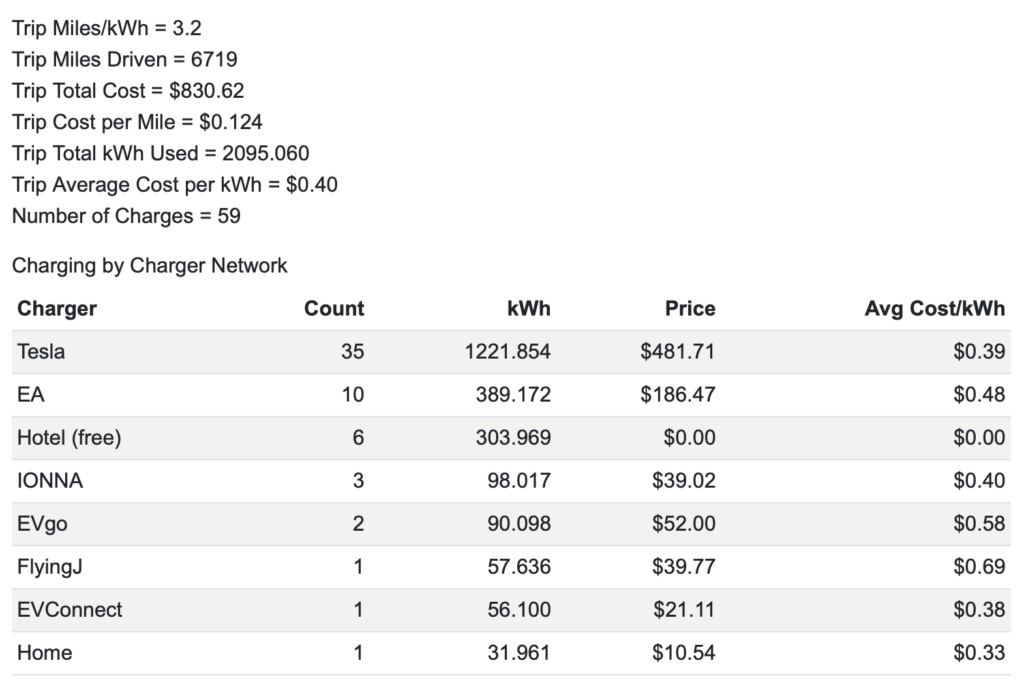
The EVConnect charge was an overnight charge at a hotel where they didn’t offer free charging. This and the six hotel charges were all to 100%.
I activated memberships for both Tesla and EA (Electrify America) before the trip and these saved me a LOT of money (especially the Tesla membership which has a much better discount than EA)! Wherever I had a choice, I went to Tesla even though it’s slower than EA; the reason was that in my experience those chargers are more consistent and less prone to problems, and Tesla is cheaper. Even though it’s rare to find a Tesla charger out of service, having one of eight or twelve down is a very different story compared to finding one or two of four EA chargers down.
FlyingJ chargers are new and solid but are very expensive; I used one because it was my only reasonable option. EVgo chargers are also expensive but in both cases they were the convenient choice. IONNA is absolutely the best network out there in my opinion, and as they continue to expand their footprint I hope to use them even more often in the future. Hyundai’s Plug and Charge works with IONNA now; it’s slow to start the session but there’s no need to deal with a credit card (even though IONNA has solid CC functionality on their chargers).
In all, I spent 14 hours and 27 minutes at DC Fast Chargers on this trip, roughly a 12% “tax” on top of my total driving time or about 7 minutes per hour of driving. One of those charging sessions was 52 minutes charging from 31-100% at a Tesla location, but I spent that time enjoying a meal a half block away so this was sort of “free” time. Overall, and if overnight charging at hotels didn’t exist, I’d use a rough rule-of-thumb of allowing 10-12 minutes of charging time per hour of interstate driving (in warm weather – cold weather will be a higher percentage of charging-to-driving).
The average price of gasoline I saw was somewhere around $4.10 this year. With that price, my efficiency of 3.2 miles/kWh, and my average of $0.40/kWh, my car was the cost-equivalent of a gasoline car getting 39 mpg. That’s less than my previous Sonata Hybrid used to get, but in exchange I enjoyed a quiet and responsive drive. I ended each day more relaxed than I would have in a normal car. That’s a good trade-off for me!